

Matthew Perry died of ‘acute effects of ketamine’ – what you need to know about the drug

Matthew Perry. s_bukley/Shutterstock

Philip Crilly, Kingston University

Millions of people worldwide were left devastated by the death this year of 54-year-old Matthew Perry, the Friends star famous for bringing wise-cracking Chandler Bing to life. A global superstar, recently sober with an autobiography on the bestseller lists, it looked like his troubled past was behind him. So the world was especially shocked and saddened to learn of his untimely death by apparent drowning.

This week, medical officials in Los Angeles, have confirmed that his drowning was more complex than initially suspected. Toxicology reports have indicated that two drugs were in Perry’s system at the time of his death. These were buprenorphine, a drug used to treat opioid drug addiction, and ketamine, sometimes referred to as special K or horse tranquilliser.

Given Perry’s well-documented addiction issues to opioid painkillers, his use of buprenorphine was not a surprise. But why was he taking ketamine?

Ketamine works by acting on receptors in the brain and, since its synthesis in the 1960s, has been used in veterinary medicine and also as a surgical anaesthetic in humans.
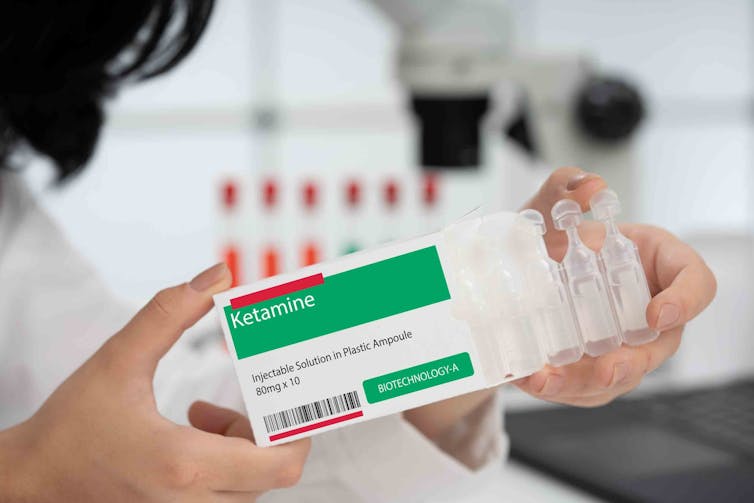
Medical person holding ampoules of ketamine
Ketamine is used as an anaesthetic in humans. luchschenF/Shutterstock

Following signs that ketamine might affect user mood, it was investigated for its potential role in treating depression and anxiety. Today, users can be prescribed ketamine for these conditions, but usually only after other antidepressant and anti-anxiety medications have failed.

The medical officer in LA specified that Perry was being legally prescribed infusions of ketamine to treat depression and anxiety. They did note, however, that given the time since his last dose, it was unlikely that the ketamine in his bloodstream was from his prescribed infusions. No other reason was offered as to why he would have had ketamine in his system so close to the time of his death.

In addition to finding drugs in his body, Perry was also listed as having heart disease. Ketamine can cause an increase in blood pressure and heart rate, so it is not surprising to hear from the medical examiner that: “At the high levels of ketamine found in his post-mortem blood specimens, the main lethal effects would be from both cardiovascular overstimulation and respiratory depression.”

Another contributing factor to Perry’s death was listed as drowning. So does ketamine make drowning more likely?

Ketamine can cause users to have issues with coordination, and they may feel disorientated. The combination of these effects while in water, can make a person’s reactions slower, putting them at risk of harm, so ketamine certainly could make drowning more likely.

Also, taking ketamine with other substances, like alcohol, can increase the risk of drowsiness. While Perry had a much-publicised issue with alcohol, his toxicology report indicated no alcohol in his system at the time of his death.

Not the first

Sadly, Perry is not the first Hollywood star to die by drowning under the influence of drugs. In 2012, global star Whitney Houston died in a bathtub after consuming marijuana, cocaine, and the benzodiazepine known as alprazolam (Xanax).

These stories remind us all of the dangers of substance abuse and the importance of seeking professional help for addiction issues.

Matthew Perry was a vocal advocate for more addiction support services, and since his death the Matthew Perry Foundation has been set up to help those struggling with the disease of addiction.

Perry said: “When I die, I don’t want Friends to be the first thing that’s mentioned, I want helping others to be the first thing that’s mentioned. And I’m going to live the rest of my life proving that.”

In the last years of his life, he did just that. But sadly, it seems that it will be in death that he will have the biggest impact on helping others to overcome their demons.

Philip Crilly, Senior Lecturer in Pharmacy Practice and Digital Public Health, Kingston University

This article is republished from The Conversation under a Creative Commons license. Read the original article.


Harold Shipman was arrested a quarter of a century ago, but we still have problems with prescribing controlled drugs

Oleg Troino/Shutterstock

Philip Crilly, Kingston University

Catherine Hudson drugged two patients on the stroke ward of Blackpool Victoria Hospital to give herself an easier life. She has been jailed for seven years and two months. Her colleague, Charlotte Wilmot, who conspired with her to drug a third patient, was given a three-year jail term.

The trial highlighted the easy access staff had to controlled drugs. The drug regimen on the stroke ward was described during the trial as “dysfunctional”. But why is this still happening? Wasn’t it all meant to have been sorted following the Shipman Inquiry?

Harold Shipman, a seemingly mild-mannered family doctor, was responsible for the deaths of over 200 of his patients over 23 years. The true horrors of his actions started to slowly unravel in September 1998 when he was arrested for the murder of one of his patients, 81-year-old Kathleen Grundy.

It was the vigilance of Grundy’s daughter, Angela Woodruff, that would set in motion a series of events that would ultimately bring an end to Shipman’s long-running killing spree that began in the 1970s. Until that point, he had been able to kill his patients undetected by being careful to cover up his tracks.

There was a collective denial by the British public that a family doctor could have harmed one of his patients, let alone many of them. Yet, at the conclusion of his murder trial in January 2000, Shipman was found guilty of the murder of 15 of his patients. The true number of his victims, however, is believed to be 215.

Most of the victims were elderly women and Shipman’s weapons of choice were the controlled drugs, diamorphine, morphine and pethidine – strong opioid painkillers.

Controlled drugs are those deemed by governments to pose a high risk to the public due to being addictive or harmful. Shipman administered these drugs to his patients in high doses. At the doses administered, the victims would have quickly lost consciousness and developed breathing difficulties before passing away.

Following Shipman’s conviction, governments around the world sought to ensure that their controlled drugs regulations were sufficient to prevent similar events in the future.

Shipman Inquiry

The Shipman Inquiry was set up by the British government in 2001 to understand how one person could have used controlled drugs so freely to harm their patients and to determine what procedures needed to be put in place to prevent another person doing the same again.

The inquiry recommended not only a cultural change within the medical and pharmaceutical professions, but also the need for new laws to protect the public.

In its fourth report, the Shipman Inquiry focused on the management and regulation of controlled drugs. It recommended better monitoring of them, with running balances being kept for the sale and supply of specific controlled drugs in controlled drug registers.

Harold Shipman mug shot.
Harold Shipman, one of the most prolific serial killer in modern times. Wakefield Prison/Wikimedia Commons

In addition, a team of inspectors was to be appointed to check that controlled drug registers were being kept accurately, to track the prescribing of controlled drugs, and to monitor those who were prescribing them.

The inquiry recommended clamping down on self-prescribing and prescribing of controlled drugs for family members. It also limited the quantity that could be prescribed at any one time to a 28-day supply.

While the Shipman Inquiry only had oversight in the UK, its recommendations were relevant to an audience of global healthcare professionals and governments.

Still a problem

Despite all the changes, 25 years after Shipman’s arrest, controlled drugs are still a global problem.

While many of these medications have an important place in pain management, particularly for those with cancer, they are prone to abuse and misuse. In 2021 alone, the NHS spent over half a billion pounds on controlled drugs, and in the US, the opioid pandemic continues to rage, with people becoming addicted to opioid painkillers, like morphine and fentanyl, after obtaining them from registered prescribers.

The governance and oversight of controlled drug prescribing, in all healthcare settings, is still not as “robust as it should be”, according to the Care Quality Commission (CQC) in the UK.

It has suggested that digital tools, such as ePACT2, will allow authorised users to identify questionable prescribing of controlled drugs so that early interventions can be implemented to ensure safe care of patients.

In the US, prescription drug monitoring programmes are being used in a similar way to give real-time, controlled drug prescribing data to enhance care.

But just as these new tools come into play, more challenges are coming to light. The emergence of non-medical prescribers (paramedics, podiatrists, pharmacists, nurses, radiographers and physiotherapists) adds to the number of people who can prescribe controlled drugs, and, therefore potentially abuse and misuse them.

Winning the war on controlled drugs will continue to be a challenge. New drugs are brought to market every year, with the potential to cause harm and be categorised as controlled drugs. As such, the management of these drugs needs to remain fluid, with healthcare professionals and governments working together to protect the public from harm.

Philip Crilly, Senior Lecturer in Pharmacy Practice and Digital Public Health, Kingston University

This article is republished from The Conversation under a Creative Commons license. Read the original article.

Social media and pharmacy – are we missing an opportunity?

reemFile_000

Dr Reem Kayyali and Philip Crilly

Facebook, Twitter and Instagram are just three social media platforms that are taking the world by storm.

According to a report by Ofcom, “In the UK, nearly all 16-34s are online (98%) and two-thirds (66%) of them have social networking profiles. Those who have a current online profile (96%) have one on Facebook and 83% of 16-24s visit social networking sites more than once a day.” People aged 55 and older now represent the fastest-growing age segment in global social networking usage, with the penetration of social networks in this age group being around 80%.

Recent research on social media use suggests that there are no significant differences in use by race, ethnicity or socioeconomic status. This suggests that health interventions delivered by social networking sites may be an effective way to reach adults from different genders, ethnicities and socioeconomic groups. Such factors have proven to be barriers for some patients accessing services from pharmacies.

Social media offers pharmacist’s innovative opportunities to further enhance their role in educating patients on healthy living initiatives. With the younger generation growing up with this technology, evidence suggests that this has increased their levels of sedentary lifestyle with a massive impact on obesity levels among the young. Pharmacists can harness this by using it to promote healthy behaviours such as weight loss, alcohol awareness and physical activity in a way that ensures they are engaged.

As patient acceptance increases and pharmacists become more familiar with the concept of social media as a health education tool they will find that it is a quick and convenient route to keep track of health outcomes allowing them to not only support individual patients but also the wider public.

In fact, at Kingston University we have tried to investigate this concept as a tool for public health promotion. Students promoted topics ranging from smoking cessation to stress relief and nutrition. The outcome was, not only did the public learn about these health topics through the evidence based posts, the students also learned from creating and posting these meaning a unique learning opportunity which current pharmacists can also benefit from.

Social media can be used to highlight the key role that pharmacy plays in supporting patients with their health needs. It can be used as a health promotion tool and is a good way to build links within the local communities and beyond. It raises the profile of the profession and also offers a unique opportunity for pharmacists to share and showcase good practice.

Managing your weight

obese-women4001

The number of people in the United Kingdom who are overweight or obese is starting to spiral out of control. Current statistics suggest that over 50% of British adults are overweight and many of these are at risk of becoming obese.

With a population becoming increasingly overweight the risks of heart disease, diabetes and other long term health complications are reaching scary heights.

Weight loss programmes range from diet based schemes like weight watchers, to self help books such as Dr Atkins diet to those that combine diet and exercise classes like Rosemary Conley’s eat yourself slim diet.

What are the risks associated with being overweight

As mentioned, being overweight can have a serious impact on our health. Some of the risks associated with obesity include

  • Heart Disease
  • High Blood Pressure
  • Cholesterol problems (leading to heart disease)
  • Stroke
  • Type 2 Diabetes (the kind you develop rather than are born with)
  • Cancers (prostate, gallbladder, colorectal, breast, endometrial and kidney)
  • Sleep Apnea (Snoring and difficulty breathing while sleeping)
  • Reproductive problems (irregular periods, increased birth defects, especially neural tube defects, and an increased risk of death of the mother and baby).

What diets are out there currently?

Currently, there are a huge abundance of ‘fad’ diets on the market. Very often these diets give us short term results and in the long term, many people actually put on more weight. The reason these fad diets work initially is because they make us dramatically cut the calories we consume so therefore we will naturally lose weight.

The problem with ‘fad’ diets is that they usually aren’t easy to maintain. As soon as you go back to your normal life, the weight generally goes back on.

The key to losing weight and keeping it off is to make the appropriate lifestyle changes and to stick to them. A diet low in fatty, processed foods and high in fruit and vegetables helps us maintain a healthy physique.

What role does exercise have in weight management?

When you exercise you burn calories. The more vigorous exercise you do, the more calories you burn and the more weight you lose. Current recommendations suggest that we should aim to do five thirty minute sessions of exercise per week. Ideally, we should aim to combine cardiovascular exercises like swimming, which help heart health, with weight-baring exercises such as squats or running which help to build strong joints.

Exercise, is not only key to weight management, other benefits include:

  • It helps you manage your mood – exercise triggers brain chemicals that make you feel good. Regular exercise is encouraged to combat depression.
  • You’ll feel more energetic
  • You’ll sleep better
  • If you do exercise with friends it can even be fun.

Maintaining a healthy weight helps ward off many serious illnesses. Just making a few small lifestyle changes involving diet and exercise can dramatically improve our health in the future.


Changes to alcohol unit guidelines in the UK – January 2016

Video

Changes to alcohol unit guidelines in the UK
January 2016

You may have heard the news recently that the UK government has made changes to the advice it gives on drinking alcohol.

Whereas before men were advised that they could drink more alcohol than women (21 units for men, 14 units for women), this has now changed. Men and women are now advised that they should each drink a maximum of 14 units of alcohol per week.

In addition, the guidelines suggest that these units should be spread across at least 3 or more days per week and that you should include regular alcohol-free days

Binge drinking is also not advised; it has been associated with a greater risk of short term health problems, like the dreaded hangover, as well as the longer term risks of causing certain cancers.

For pregnant women the advice is not to drink alcohol at all.

Some tips on keeping on top of your alcohol:

• When drinking, try to do so with a meal
• Have a glass of water or a soft drink in between alcoholic drinks
• Try some alcohol-free alternatives

Further reading

The drinkaware fact sheet about the new alcohol unit guidelines:
https://www.drinkaware.co.uk/check-the-facts/what-is-alcohol/new-government-alcohol-unit-guidelines#guidelines

The drink aware App can help you to keep track of your drinking: https://www.drinkaware.co.uk/app

How to calculate a unit of alcohol
http://www.nhs.uk/Livewell/alcohol/Pages/alcohol-units.aspx

Government link to new alcohol guidelines:
https://www.gov.uk/government/news/new-alcohol-guidelines-show-increased-risk-of-cancer

BBC news article on the new alcohol guidelines:
http://www.bbc.co.uk/news/uk-35252650

NHS guidance on new alcohol guidelines and how to manage your drinking:
http://www.nhs.uk/news/2016/01January/Pages/New-alcohol-advice-issued.aspx

UK Chief Medical Officer, Summary of proposed guidelines:

Click to access summary.pdf